Trues Toys
Why are wooden toys better long-term? Many parents ask this after watching plastic toys crack, fade, or lose their appeal within months. Wooden toys often feel different from the start. Their weight is noticeable in a child’s hands. Their surfaces show natural grain. A simple wooden train can become a bridge, a shop, or a castle during open-ended play. This flexibility may support creativity without depending on lights, sounds, or batteries.
Durability is a practical advantage. Well-made wood can survive repeated drops, shared play, and storage between siblings. Small scratches may become part of its history rather than an immediate reason to replace it. Many wooden toys can also be cleaned, repaired, or passed to another family. That reduces waste over time, although the environmental benefit depends on responsible timber, safe finishes, and durable design. Not every wooden toy is automatically sustainable.
Safety still requires careful judgment. Reliable manufacturers should provide clear age guidance, smooth edges, secure parts, and tested, non-toxic coatings. Parents should inspect loose wheels, chipped paint, and splintered surfaces regularly. Professional guidance on age-appropriate play matters more than material alone. Wooden toys can be heavier, more expensive, and less convenient for travel. Some children may prefer bright electronic features. That is perfectly reasonable. The strongest long-term choice is not always the most beautiful one. It is the toy that remains safe, useful, repairable, and genuinely interesting after the first exciting week.
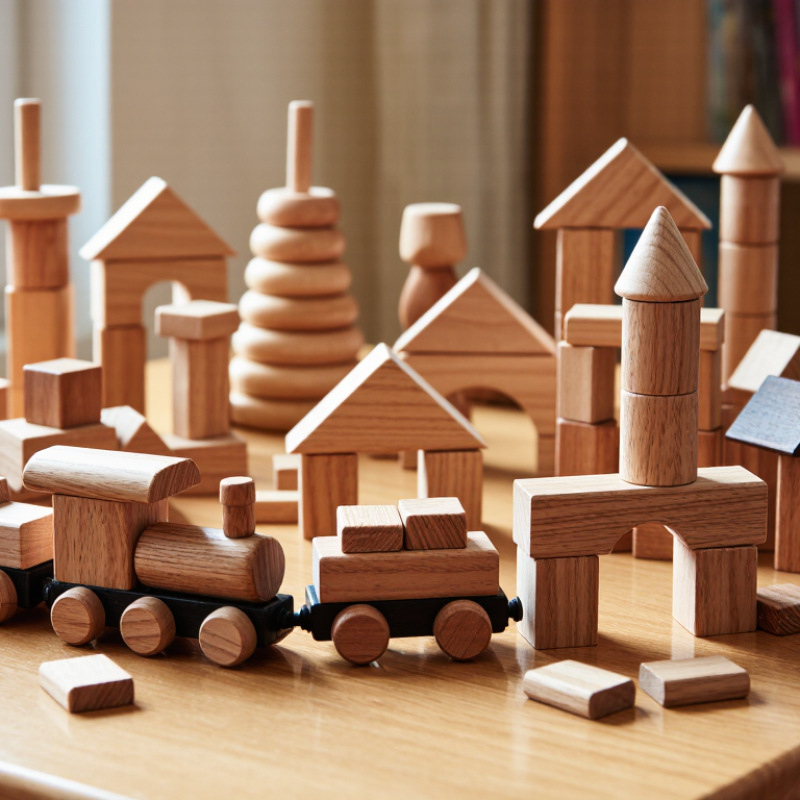
Wooden toys often last longer because hardwood resists dents, crushing, and repeated handling. A density of 600–800 kg/m³ gives many hardwoods a useful balance between strength and manageable weight. When a wooden block falls from a low table, its surface may show a small mark instead of a deep fracture. The result is less visible damage over years of play.
Density is not the whole story. Grain direction, moisture content, joint design, and surface treatment also affect service life. In practical inspections, dense wood with poorly sealed end grain can still absorb moisture and develop small cracks. A smooth finish helps, but it cannot repair weak construction. I once assumed heavier wood always meant better quality. That assumption was too simple.
Parents can check for rounded edges, tight joints, and cleanly sanded surfaces. These details reduce wear where small hands grip, stack, and drop toys. Hardwoods within the 600–800 kg/m³ range generally tolerate repeated contact better than very soft wood, though species vary considerably. Density measurements also change with moisture, so published figures need careful interpretation. A toy that survives years of handling still needs occasional inspection for loosened parts, splinters, or damaged coatings. Small defects matter.
Top Reasons Why Wooden Toys Are Better Long Term?
Ten-Year Ownership Costs: Wooden Toys Versus Plastic Replacement Rates
A ten-year cost comparison often favors wooden toys, but the result depends on use. A $30 wooden vehicle lasting ten years costs about $3 annually. A $12 plastic vehicle replaced every two years costs $60 over the same period. That is before shipping, batteries, and disposal. However, no reliable industry report provides one universal plastic-toy replacement rate. Household behavior varies widely. Some plastic toys survive for years; others crack after one season.
The OECD’s Global Plastics Outlook reports that global plastic waste doubled from 2000 to 2019, while only 9% was recycled. U.S. EPA data also recorded 35.7 million tons of plastic waste in municipal systems during 2018. These figures do not prove wooden toys always last longer. They do show why repeated replacement deserves attention. Wood can be sanded, repaired, and reused. Plastic usually becomes difficult to restore after broken hinges or missing parts. I have found the repair advantage persuasive, though wooden parts can split when stored damply.
Tips: Track each toy’s purchase price, repair cost, and replacement date. Use a simple ten-year spreadsheet. Include storage, batteries, and resale value. Check safety labels and inspect loose parts regularly. A durable toy is not automatically a sustainable toy if it remains unused.
Sources: OECD, Global Plastics Outlook, 2022; U.S. EPA, Advancing Sustainable Materials Management: 2018 Fact and Figures.
| Cost and Durability Measure | Wooden Toy | Plastic Toy | Calculation or Interpretation |
|---|---|---|---|
| Typical purchase price per unit | $30 | $15 | Illustrative mid-range prices for comparable, single-purpose toys. |
| Expected usable life per unit | 10 years | 2 years | Planning assumptions for normal household use and proper storage. |
| Estimated units needed over 10 years | 1 unit | 5 units | 10-year ownership period divided by expected usable life. |
| Initial purchase cost | $30 | $15 | Purchase price of the first toy. |
| Replacement purchases over 10 years | $0 | $60 | Wood: 0 replacements; plastic: 4 replacements × $15. |
| Routine maintenance over 10 years | $20 | $10 | Wood: occasional sanding or food-safe reconditioning; plastic: cleaning supplies. |
| Estimated repair cost over 10 years | $0 | $0 | Assumes damaged toys are replaced rather than professionally repaired. |
| End-of-life disposal events | 1 | 5 | One disposal event per unit reaching the end of its assumed life. |
| Estimated disposal cost | $0 | $0 | Assumes ordinary household disposal without paid collection fees. |
| Total ten-year ownership cost | $50 | $85 | Purchase cost + replacements + maintenance. |
| Average cost per year | $5.00 | $8.50 | Total ten-year ownership cost ÷ 10 years. |
| Potential ten-year saving with wooden toy | $35 | — | $85 plastic ownership cost − $50 wooden ownership cost. |
| Potential cost reduction | 41.2% | — | $35 savings ÷ $85 plastic ownership cost. |
Wood can age well, but “natural” does not mean automatically safer. Paint, varnish, glue, and surface coatings can introduce chemical risks. ASTM F963-23 became mandatory for toys in the United States on April 20, 2024. It addresses heavy elements, phthalates, small parts, sound, and other hazards. Testing must examine the finished toy, not bare wood alone.
CPSC’s 2023 Toy-Related Deaths and Injuries report estimated 231,000 toy-related emergency-department injuries among children under 15 in the United States. Chemical exposure is only one concern, but it deserves quiet scrutiny. Long-term value depends on durable construction and verified compliance.
Ask for current test reports against ASTM F963-23 or EN 71-3. Look closely at chipped edges and worn finishes. Small flaws become bigger questions.
Wooden toys can last for years, yet poorly controlled coatings may not. This is where my earlier assumption needs revision: material choice helps, but manufacturing evidence matters more.
Wooden toys can remain useful for years, but sustainability depends on more than appearance. FSC certification offers a traceable starting point. It links timber to responsibly managed forests and documented supply chains. This matters when a toy has visible grain, smooth edges, and parts designed for repair. However, FSC certification does not automatically prove a product has the lowest carbon footprint. It verifies responsible forestry criteria, not every factory process or transport route.
Life-cycle assessment provides a more complete test. ISO 14040 and ISO 14044 require analysis across raw materials, manufacturing, distribution, use, and disposal. The OECD’s Global Plastics Outlook reported that plastics created about 1.8 billion tonnes of greenhouse-gas emissions in 2019. That figure covers the wider plastics system, not toys alone. It still shows why material selection deserves attention. A wooden toy may avoid some fossil-based inputs, especially when it uses durable timber and water-based finishes. Yet kiln drying, long-distance shipping, and wasted offcuts can weaken that advantage.
The honest answer is less tidy. A heavily varnished wooden toy may perform worse than a lightweight, recycled alternative. LCA results change with electricity sources, toy weight, lifespan, and end-of-life treatment. A toy used by three children for ten years can spread its manufacturing impact across thousands of play hours. That is practical evidence, not just a marketing promise. Scratches also reveal something useful: repairable materials can extend service life, though not every wooden design is easy to fix.
Wooden toys often stay useful because their parts can be inspected, repaired, and reused. A loose wheel may need one screw, not a complete replacement. A scratched surface can be sanded and refinished with a child-safe coating. In my experience, simple construction matters more than decorative detail. Fewer glued layers make repairs easier. Some toys still fail, though. Thin wood can split around drilled holes, and poor finishes may not survive frequent washing.
The U.S. Environmental Protection Agency reported that Americans discarded about 3.3 million tons of toys and playground equipment in 2018. Only about 6.8% was recycled, while roughly 80.2% went to landfills. This category includes many materials, so it does not measure wooden toys alone. Still, it shows the cost of short product lifespans.
A repairable wooden toy can move from a toddler’s shelf to a sibling’s room, then into a community toy library. That second life depends on safe materials, replaceable fasteners, and clear care instructions. The Ellen MacArthur Foundation’s circular design guidance also emphasizes durability, maintenance, and reuse over disposal. Measuring real longevity remains difficult. Families rarely record repairs or years of use. That gap deserves attention. A toy used for fifteen years may look ordinary, but its environmental value is substantial.
Divide the purchase price by expected years of use. A $30 wooden vehicle lasting ten years costs about $3 yearly. A $12 plastic vehicle replaced every two years costs $60. Include batteries, shipping, repairs, storage, and disposal. The spreadsheet may change your conclusion.
No. Household use varies greatly. Some plastic toys survive for years, while others crack after one season. Wood can split when stored in damp conditions. Construction quality matters more than material alone. That assumption needs checking.
A loose wheel may need one screw instead of a new toy. Scratched wood can sometimes be sanded and refinished. Replaceable fasteners support repeated use. Simple designs are easier to inspect and repair. Not every repair succeeds.
Record the purchase price, repair dates, repair costs, and replacement dates. Add battery purchases and storage expenses. Include possible resale or donation value. A basic ten-year spreadsheet is enough. Keep it simple.
No. Wood, paint, varnish, glue, and coatings require separate attention. A painted bead may need different testing than an unfinished block. Check whether testing covered the finished toy. Natural appearance proves very little. That point is easy to miss.
Look for current testing against recognized toy-safety requirements. Inspect loose parts, chipped edges, broken hinges, and worn finishes. Check surfaces that children may mouth or handle. Stop using toys with dangerous splinters or detached pieces. Small flaws matter.
Yes, if its materials remain safe and its structure stays sound. One toy might move from a toddler’s shelf to a sibling’s room. Later, it could enter a community toy library. Clear care instructions improve that second life. Reuse is not automatic.
Not necessarily. A durable toy creates less value when it remains unused. Long use matters more than appearance alone. Repair, sharing, and reuse can reduce replacement demand. The evidence is imperfect.
Why are wooden toys better long-term? Their durability, safety, and ability to be repaired make them a practical choice for families seeking lasting value. Many hardwoods have a density of approximately 600–800 kg/m³, giving toys strong resistance to cracking, bending, and everyday wear. Although wooden toys may cost more initially, their longer service life can reduce ten-year ownership costs by avoiding the frequent replacements often associated with fragile plastic toys. Their solid construction also makes cleaning and maintenance simpler when properly designed and cared for.
Long-term value also depends on responsible production and safe materials. Toys manufactured to meet benchmarks such as ASTM F963-23 and EN 71 should undergo evaluations for physical safety and chemical migration limits. FSC certification can support responsible forestry, while life-cycle assessments help compare environmental impacts from production through disposal. Most importantly, wooden toys can often be sanded, repaired, repainted with suitable safe finishes, or passed between siblings and generations, extending their useful life and reducing waste.
