Trues Toys
Sensory toys are becoming familiar in Chinese homes, kindergartens, and therapy settings. They include textured balls, silicone poppers, stacking blocks, sound tubes, and weighted lap pads. Why are sensory toys good for children? They give children safe ways to touch, squeeze, move, listen, and explore. These actions can support fine-motor control, hand strength, coordination, and attention. A child might press a soft button before writing, or sort bright shapes after a busy classroom day. Small actions can build confidence.
For children from China, sensory toys may fit different routines and learning environments. Some families use them during quiet play, travel, homework breaks, or bedtime preparation. Occupational therapists and early-childhood educators often recommend sensory activities when they match a child’s needs. However, a toy is not a treatment by itself. No single product suits every child. Some children dislike rough textures or sudden sounds. Parents should observe carefully, choose age-appropriate materials, and check for small parts, strong odors, and loose components. Reliable manufacturers should provide clear instructions and transparent safety information. Quality matters more than novelty. I have also seen adults expect immediate calm from a new toy, which is unrealistic. Children need time, choice, and patient guidance. A simple textured ring may help one child focus, while another prefers quiet blocks. This guide explores the practical, developmental, and cultural reasons these toys can support children in China, without treating every family or child as the same.
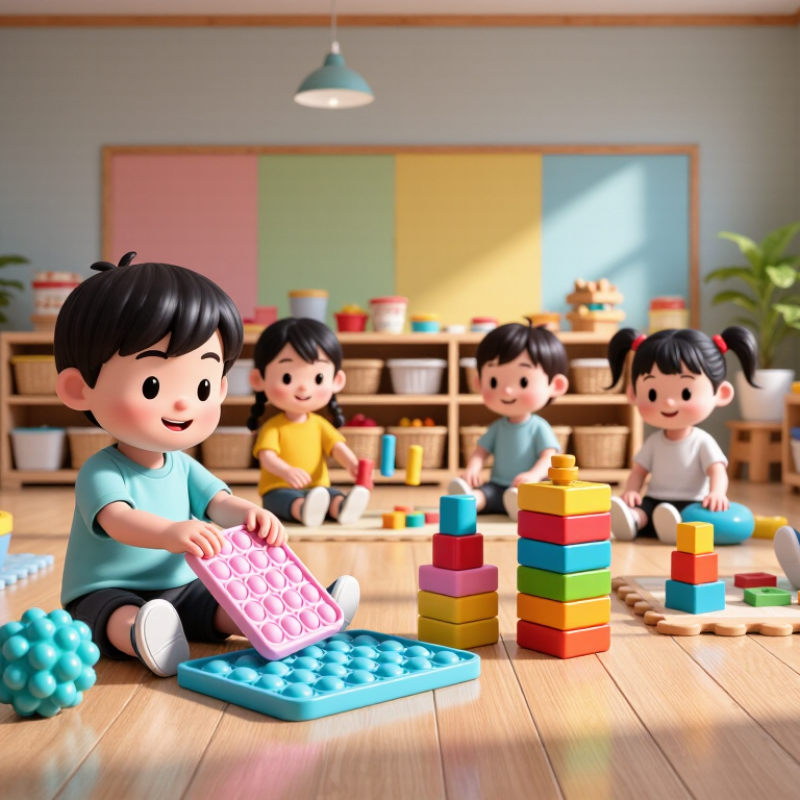
Sensory toys help children explore how their bodies receive and organize information. A textured ball stimulates touch. A balance board challenges the vestibular system. Putty, squeezing tools, and resistance bands engage proprioception, which helps children notice muscle movement and body position. Sound tubes and color cards add auditory and visual input. These experiences can support play-based learning for children growing up in China, whether at home or in early-learning classrooms.
Play makes learning active. A child may sort objects by texture, describe a sound, or build a simple route with balance stones. These tasks encourage language, coordination, attention, and problem-solving. The UNICEF and LEGO Foundation report Learning through Play (2018) identifies playful interaction as important for cognitive, social, emotional, and physical development. The American Academy of Pediatrics also recommends simple toys that encourage caregiver interaction, imagination, and hands-on discovery.
They are not magic.
A textured toy may calm one child and irritate another. Adults should observe facial tension, avoidance, excitement, and fatigue instead of forcing participation. A frequent mistake is calling every sensory activity therapy. It is not a substitute for professional assessment. Safety also needs evidence: the U.S. Consumer Product Safety Commission’s 2023 report estimated 231,700 toy-related injuries treated in American emergency departments. For toys made in China, check age grading, choking-risk warnings, material declarations, and independent test records. Small parts need careful supervision.
Sensory play supports development through touch, movement, sound, and visual exploration. For children in China, these activities can fit naturally into home, kindergarten, or therapy routines. A child may squeeze soft clay, sort textured objects, or follow a slow movement path. These simple actions can strengthen hand control, body awareness, attention, and emotional regulation.
Tips: Begin with two or three textures. Watch the child’s face, breathing, and posture. Stop if the child becomes distressed. Offer choices, such as a brush, foam, or water tray. Keep sessions short, perhaps five to ten minutes. Record what happened. A pediatric occupational therapist can help interpret patterns, especially when sensitivity affects eating, sleep, dressing, or classroom participation. Different children respond differently. Culture, space, noise, and family routines also matter.
Why Are Sensory Toys Good for Children from China?
The WHO estimates that about 1 in 100 children worldwide has autism. This figure is important, but it does not describe every child’s needs. Autism can affect communication, attention, movement, and responses to sound or touch. A child in China may feel calmer with a quiet corner, textured ball, or soft putty during a busy school day. These toys can support self-regulation, but they are not cures or replacements for professional care. A pediatric occupational therapist can help identify useful sensory activities. Family routines and cultural expectations also matter. A toy should fit the child, not a general label.
Tips: Watch the child’s response before offering more stimulation. Try one toy at a time, such as a silent fidget or weighted lap pad. Keep sessions brief. Stop if the child covers their ears, avoids touch, or becomes distressed. Ask caregivers and teachers what works at home and school. Avoid assuming that bright colors or loud sounds are helpful. Sometimes less is better. A common mistake is choosing a popular toy instead of observing the child. That choice deserves reconsideration. Safety checks remain essential, especially for small parts and materials that may enter the mouth.
Sensory toys may support play, communication, attention, or self-regulation for some children, but their usefulness depends on each child’s sensory preferences and developmental needs. Autism prevalence estimates vary by country, age, and measurement method; they should not be used to predict an individual child’s needs.
The World Health Organization estimates that approximately 1 in 100 children worldwide has autism. The U.S. CDC reported an estimate of 1 in 31 children aged 8 in its 2022 surveillance data. These figures are not directly comparable and do not represent a China-specific prevalence estimate.
Sources: World Health Organization, “Autism,” 2023; U.S. Centers for Disease Control and Prevention, Autism and Developmental Disabilities Monitoring Network, 2022.
Sensory toys can help children explore texture, sound, movement, and pressure. A soft silicone shape may invite squeezing, while ridges and bumps give small hands clear tactile feedback. These experiences can support calm play and early motor practice. Safety still matters, especially when children mouth objects or pull attached parts.
China’s GB 6675 toy safety standard addresses physical and mechanical risks, including choking hazards from small or detachable components. Toys are assessed for age suitability, structural strength, sharp edges, and accessible parts. A sensory toy should not release beads, buttons, rings, or broken fragments during reasonably foreseeable use. Small parts require strict attention.
Clear labeling matters too. Packaging should state the recommended age, warnings, and supervision needs. Materials and chemical safety are also covered within the GB 6675 framework, alongside flammability requirements. Parents and educators should inspect toys after drops, bites, and repeated stretching. A toy that passed testing can still wear out.
This is easy to overlook.
From practical observation, textured toys often receive heavy handling because children repeat the same action many times. Manufacturers should test that pattern, not only gentle use. I would also question vague claims such as “completely safe.” No standard removes every risk. Careful design, honest labeling, and close supervision work together.
| Dimension | Relevant GB 6675 Area | Practical Safety Requirement | Why It Matters for Sensory Toys | Typical Verification Approach |
|---|---|---|---|---|
| Scope and product safety | GB 6675.1-2014: Basic specifications | Toy design, construction, labeling, and foreseeable use must be assessed for children’s safety. | Sensory products may include textured surfaces, movable pieces, sound elements, or activity components that require a whole-product risk review. | Technical documentation, product inspection, safety testing, and review of intended age information. |
| Choking and small parts | GB 6675.2-2014: Mechanical and physical properties | Toys intended for children under 36 months must not release hazardous small parts during required use and abuse tests. | This is especially relevant to detachable beads, buttons, caps, bells, detachable eyes, and other small sensory components. | Small-part assessment, tension and torque tests, drop testing, impact testing, and other foreseeable-use simulations. |
| Age grading | GB 6675.1 and GB 6675.2 | The recommended age must reflect the toy’s design, complexity, foreseeable hazards, and developmental suitability. | A toy appropriate for an older child may be unsuitable for an infant or toddler, even when it provides valuable tactile or auditory stimulation. | Age-grade review, hazard analysis, warning-label inspection, and comparison with the toy’s actual features. |
| Sharp points and sharp edges | GB 6675.2-2014 | Accessible components should not create prohibited sharp-point or sharp-edge hazards under the applicable test conditions. | Children often squeeze, rub, mouth, or press sensory toys against their skin, increasing the importance of smooth accessible surfaces. | Inspection and standardized sharp-point and sharp-edge testing of accessible parts. |
| Durability and breakage | GB 6675.2-2014 | Components should withstand specified mechanical stresses without creating dangerous fragments or detachable hazards. | Repeated squeezing, pulling, twisting, and dropping can cause failure if seams, handles, fasteners, or attachments are weak. | Mechanical abuse tests followed by examination for breakage, detachment, sharp edges, and small parts. |
| Material flammability | GB 6675.3-2014: Flammability properties | Applicable toy materials must meet the standard’s flammability requirements for their material type and construction. | Soft fabrics, plush coverings, foam, and other tactile materials can require specific flammability consideration. | Laboratory flammability testing using the procedures applicable to the toy material. |
| Restricted chemical elements | GB 6675.4-2014: Migration of specific elements | Accessible toy materials and coatings are assessed against limits for the migration of specified elements, according to the applicable material category. | Sensory toys are frequently handled and may be mouthed, so material and coating controls are important for children’s exposure. | Laboratory migration testing of relevant substrates, paints, coatings, plastics, textiles, or other accessible materials. |
| Tactile and fine-motor engagement | Developmental benefit; not a substitute for safety compliance | Textures, graspable forms, buttons, tabs, and other activities should be selected according to the child’s age and ability. | Different textures and grasping actions can encourage exploration, hand control, and coordinated movement during supervised play. | Review of ergonomic design, accessibility, age suitability, and performance after durability testing. |
| Auditory and visual stimulation | Developmental benefit; product-specific risk assessment | Sound-producing and visually interactive features should be securely constructed and suitable for the intended age group. | Colors, patterns, movement, and moderate sounds can support attention and cause-and-effect exploration without making safety claims by themselves. | Functional inspection, attachment testing, age-grade review, and assessment of accessible components. |
| Labels and warnings | GB 6675.1-2014 and applicable labeling requirements | Age information, warnings, instructions, and safety-related information should be clear, durable, and consistent with the product’s hazards. | Clear warnings help caregivers identify choking risks, supervision needs, cleaning instructions, and unsuitable uses. | Label inspection, permanence checks where applicable, and comparison with test results and product design. |
| Caregiver supervision | Safe-use principle | Compliance with a toy standard does not eliminate all risks from misuse, damage, modification, or use by an unsuitable age group. | Supervision is particularly important for mouthing behavior, water beads, loose components, and toys used by children under three. | Follow the product instructions, inspect the toy regularly, and remove damaged or detached parts immediately. |
Why Are Sensory Toys Good for Children from China?
Sensory toys can support touch, movement, focus, and calm play. For children from China, familiar colors, sounds, or cultural shapes may make play feel more comfortable. Yet the toy’s origin does not decide its safety. The child’s age, abilities, and play habits matter more.
Read the age label before buying. It should match the child’s real development, not only their birthday. A three-year-old who explores toys by mouth may need extra caution. Check for small parts, loose beads, long cords, magnets, and detachable textured pieces. The label can guide you, but it is not perfect. Children develop differently.
ASTM F963 is a useful safety benchmark for toys sold in the United States. It covers areas such as flammability, chemicals, sound levels, small parts, and certain mechanical hazards. For a toy made in China, ask the seller for current testing records linked to the exact product. Do not rely on a general factory statement. Inspect the toy yourself, too. Look for cracked plastic, sharp edges, weak stitching, or an unusual smell. Sensory play often involves close contact and repeated handling. That makes material quality especially important. I would also reconsider toys with confusing labels or missing instructions. A lower price is not proof of poor quality, but missing safety information deserves attention.
Sensory toys help children explore touch, sound, movement, pressure, and sight. Examples include textured balls, putty, balance boards, sound tubes, and color cards.
Playful sensory tasks can build language, coordination, attention, and problem-solving. A child might sort textures, describe sounds, or create a route with balance stones.
No. A textured toy may calm one child and irritate another. Watch facial tension, avoidance, excitement, and fatigue.
Not automatically. Sensory play can support exploration, but it cannot replace professional assessment or individualized care.
Stay nearby when children use small or detachable parts. Stop the activity if a child mouths pieces, becomes distressed, or shows unusual tiredness.
Read the age label and choking warnings. Check for loose beads, magnets, long cords, sharp edges, cracked plastic, and weak stitching.
Inspect it after drops, bites, and repeated stretching. A toy should not release fragments during normal, foreseeable play.
Age labels offer useful guidance, but they are not perfect. Match the toy with the child’s real abilities and habits, not just their birthday.
Ask for current test records linked to the exact product. Clear materials, warnings, supervision instructions, and age information deserve attention.
Not necessarily. Missing safety information is more concerning than a low price. I would pause before choosing a confusingly labeled toy.
Why are sensory toys good for children? They offer playful opportunities to explore touch, sound, movement, color, and texture while supporting sensory processing and play-based learning. Through these experiences, children may strengthen attention, coordination, communication, problem-solving, and emotional self-regulation. Occupational therapy research suggests that purposeful sensory activities can support development when they are matched to a child’s abilities, interests, and comfort level.
Every child has different needs, and the WHO estimates that about 1 in 100 children worldwide is autistic, making individualized play especially important. Sensory toys should be selected with safety in mind: caregivers can check age labels, inspect for small or detachable parts, and choose products that meet China’s GB 6675 safety requirements, particularly those addressing choking hazards. ASTM F963 benchmarks can also provide a useful reference when evaluating toy safety. Adult supervision and regular inspection remain essential.
